
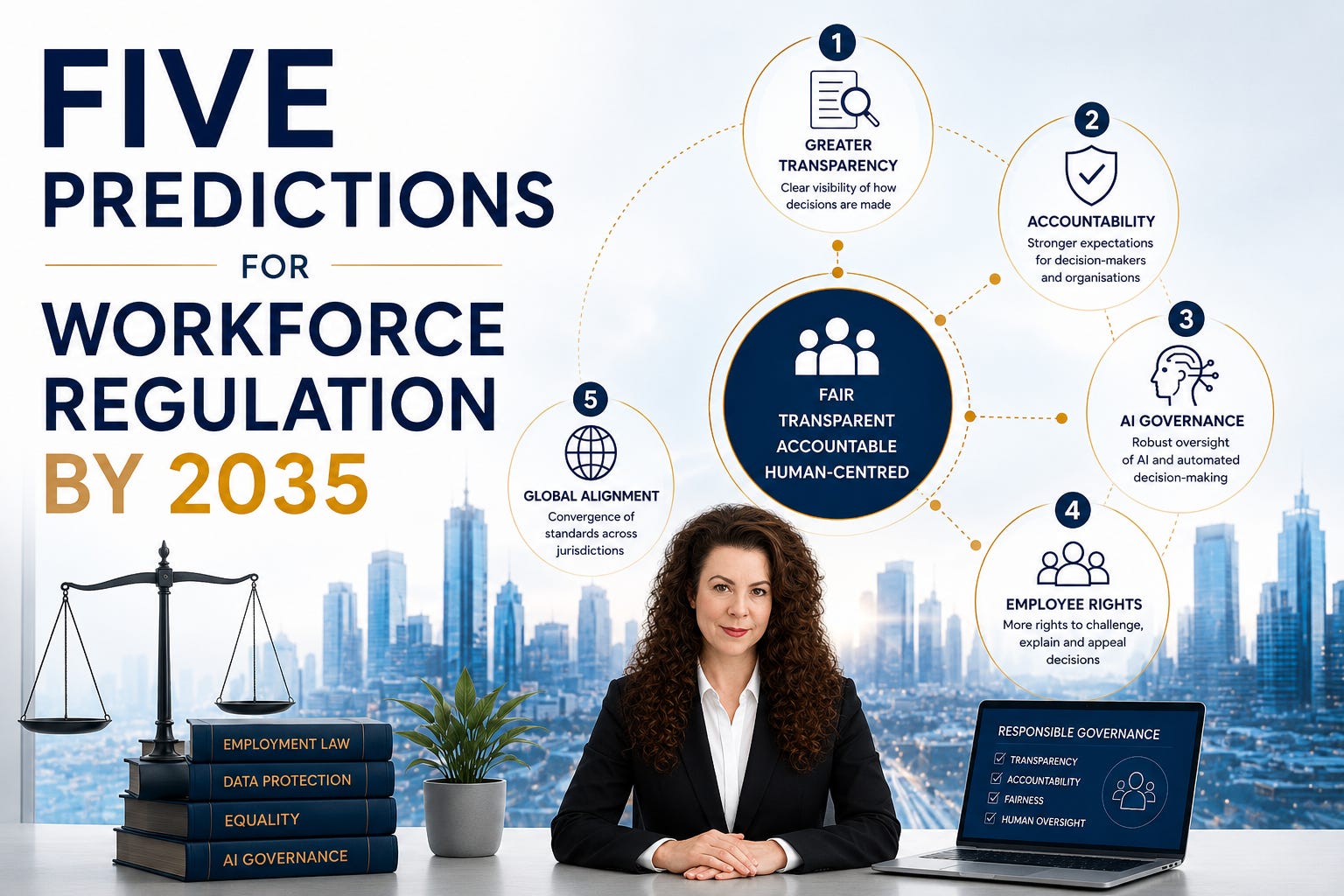
Five Predictions for Workforce Regulation by 2035
Why AI, recruitment technology, and algorithmic decision-making are changing what regulators expect from organisations

For the past three years, I have been asked a variation of the same question at conferences, board meetings, and executive roundtables:
“What regulations are coming for AI?”
It is a reasonable question. Organisations are investing heavily in artificial intelligence while regulators around the world are racing to respond. Every week seems to bring a new framework, consultation, code of practice, standard, or legislative proposal.
Yet I increasingly believe that many leaders are asking the wrong question. The issue is not what regulations are coming.
“The issue is what regulators are ultimately trying to achieve?”
When we look beyond the headlines, a remarkably consistent pattern emerges. Whether we examine the Information Commissioner’s Office (ICO), the European Union AI Act, the US Equal Employment Opportunity Commission (EEOC), Ofcom, the Financial Conduct Authority, NIST, or emerging international standards, they are all moving towards the same destination.
They are not attempting to regulate technology. They are attempting to govern decisions.
That distinction matters because artificial intelligence changes one of the most fundamental assumptions underpinning modern organisations.
Historically, accountability sat with people. Managers hired employees. Leaders approved promotions. Executives made strategic decisions. Technology supported those activities but rarely participated directly in them.
Today that boundary is becoming increasingly blurred.
Algorithms shortlist candidates, assess performance indicators, recommend promotions, identify skills gaps, predict workforce attrition, and increasingly shape organisational outcomes before a human becomes involved.
The Organisational Regulatory Challenge
The regulatory challenge is therefore no longer primarily technical. It is organisational.
How do we maintain accountability when decisions are increasingly distributed across people, algorithms, data systems, vendors, automated workflows, and machine-generated recommendations?
The answer to that question is already beginning to appear within regulation itself.
In March 2026, the ICO publicly stated that automated decision-making in recruitment can improve efficiency but warned that organisations must implement appropriate safeguards, transparency, and lawful oversight mechanisms. The regulator has also made automated decision-making in recruitment a specific area of regulatory focus within its wider AI and biometrics strategy. (Information Commissioner’s Office)
At the same time, the UK’s Data (Use and Access) Act 2025 significantly reshaped the country’s approach to automated decision-making by replacing the previous Article 22 framework with new provisions covering automated decisions and associated safeguards. While the legislation introduces greater flexibility for organisations, it also reinforces expectations around transparency, challenge mechanisms, and accountability. (Farrer & Co.)
Across Europe, the direction is even more explicit.
Under the EU AI Act, many recruitment, hiring, workforce management, and employment-related AI systems are classified as “high-risk”. These systems are expected to operate within formal risk management frameworks, human oversight requirements, transparency obligations, documentation controls, and governance processes. Employers deploying such systems may be required to inform employees and worker representatives when high-risk AI is being used within workplace decision-making. (Eversheds Sutherland)
Meanwhile in the United States, regulators are approaching the issue through employment discrimination law.
The EEOC has repeatedly warned that employers remain accountable for discriminatory outcomes even when decisions are influenced by third-party AI systems. Federal guidance has increasingly focused on algorithmic discrimination, disability discrimination, bias monitoring, explainability, and the legal responsibilities of employers deploying automated employment technologies. (EEOC)
Three different jurisdictions.Three different legal traditions.
Yet all are moving towards the same conclusion.
Organisations must be able to demonstrate how decisions are made, how risks are governed, and who remains accountable when AI influences outcomes.
Against that backdrop, five developments now appear increasingly likely.
Prediction One: Organisations Will Be Required to Disclose AI Influence in Employment Decisions
Today many candidates have little visibility into how AI influences hiring outcomes. That position is becoming increasingly difficult to defend.
The future candidate experience is likely to include far greater transparency regarding where AI is used, how it contributes to decisions, and what role human judgement continues to play.
The debate will gradually move beyond whether AI was used. The more important question will become whether individuals understood how AI influenced the outcome.
Prediction Two: Decision Traceability Will Become a Regulatory Expectation
Most organisations can explain their policies. Far fewer can reconstruct a decision. This distinction will become increasingly important.
As automated decision-making expands, organisations will need to demonstrate not simply what decision was reached but how it was reached, what evidence informed it, which systems contributed to it, and where human oversight intervened.
Recruitment decisions will increasingly require auditable decision trails in the same way financial decisions already do.
Prediction Three: Boards Will Become Accountable for AI-Influenced Workforce Decisions
The era of treating AI as purely a technology issue is rapidly ending.
Employment decisions now sit at the intersection of legal risk, workforce strategy, governance, reputation, operational resilience, and regulatory compliance. Future investigations are unlikely to focus exclusively on algorithms.
They will increasingly examine governance structures, escalation pathways, oversight mechanisms, accountability frameworks, and executive decision-making.
The boardroom is becoming part of the AI governance landscape.
Prediction Four: Regulation Will Shift from Employment Processes to Decision Systems
Historically, regulators assessed whether organisations followed appropriate procedures. Increasingly they will assess how decisions are generated, challenged, reviewed, evidenced, and governed across interconnected human and technological systems.
This changes the focus from individual actions to organisational architecture.
In AI-mediated organisations, governance can no longer be evaluated solely by examining people. It increasingly requires visibility into the wider ecosystem of technologies, workflows, controls, and decision pathways that shape outcomes.
Prediction Five: Decision Governance Will Become a Core Organisational Capability
Perhaps the most significant shift will not come from regulation itself. It will come from operational necessity. As AI adoption accelerates, organisations are discovering that traditional management structures provide limited visibility into how decisions actually flow through the business.
The visible organisation chart increasingly tells only part of the story. Beneath it sits a far more complex network of human judgement, algorithmic recommendations, automated workflows, external vendors, data dependencies, and machine-generated insights.
Organisations that cannot see these decision flows will struggle to govern them.
By 2035, regulators are unlikely to have separate “AI workforce regulations” sitting in isolation. What is emerging is a broader framework governing how workforce decisions are made, evidenced, challenged, and overseen, regardless of whether those decisions involve AI, humans, agents, automation, or a combination of all four.
The strongest organisations by 2035 will not necessarily be those with the most advanced AI. They will be those with the clearest understanding of how decisions are made, challenged, evidenced, governed, and trusted. Because when we look closely at the direction of regulation around the world, one conclusion becomes increasingly difficult to ignore.
Most people think the next decade will bring AI regulation. I think it will bring something much bigger. The emergence of workforce regulation designed for a world in which decisions are increasingly influenced by AI, automation, algorithms, digital platforms, and autonomous agents.
The future of regulation is unlikely to focus on technology alone. It will focus on accountability for the decisions that technology helps create and that visibility will shine a light on humans in the future.
References
UK Regulation and ICO
Information Commissioner’s Office (ICO) (2026) Automated decisions can streamline the hiring process, with the right safeguards in place. Available at: http://ico.org.uk/about-the-ico/media-centre/news-and-blogs/2026/03/automated-decisions-can-streamline-the-hiring-process-with-the-right-safeguards-in-place/ (Accessed: 30 May 2026).
Information Commissioner’s Office (ICO) (2026) Recruitment Rewired: Automated decision-making in recruitment. Available at: http://ico.org.uk/about-the-ico/what-we-do/recruitment-rewired/ (Accessed: 30 May 2026).
Information Commissioner’s Office (ICO) (2026) ICO consultation on draft guidance about automated decision-making, including profiling. Available at: http://ico.org.uk/about-the-ico/ico-and-stakeholder-consultations/2026/03/ico-consultation-on-the-draft-guidance-about-automated-decision-making-including-profiling/ (Accessed: 30 May 2026).
Information Commissioner’s Office (ICO) (2026) AI and Biometrics Strategy Update – March 2026. Available at: http://ico.org.uk/about-the-ico/our-information/our-strategies-and-plans/artificial-intelligence-and-biometrics-strategy/ai-and-biometrics-strategy-update-march-2026/ (Accessed: 30 May 2026).
UK Government (2025) Data (Use and Access) Act 2025. Available at: http://www.legislation.gov.uk/ukpga/2025/18/contents/enacted (Accessed: 30 May 2026).
UK Government (2025) Data (Use and Access) Act 2025: Data Protection and Privacy Changes. Available at: http://www.gov.uk/guidance/data-use-and-access-act-2025-data-protection-and-privacy-changes (Accessed: 30 May 2026).
European Union
European Union (2024) Artificial Intelligence Act (Regulation (EU) 2024/1689). Available at: http://artificialintelligenceact.eu/high-level-summary/ (Accessed: 30 May 2026).
European Union (2024) Annex III: High-Risk AI Systems. Available at: http://artificialintelligenceact.eu/annex/3/ (Accessed: 30 May 2026).
Eversheds Sutherland (2026) EU AI Act: High-Risk AI Systems in Employment. Available at: http://www.eversheds-sutherland.com/en/global/insights/eu-ai-act-high-risk-ai-systems-in-employment (Accessed: 30 May 2026).
Clifford Chance (2024) What Does the EU AI Act Mean for Employers? Available at: http://www.cliffordchance.com/content/dam/cliffordchance/briefings/2024/08/what-does-the-eu-ai-act-mean-for-employers.pdf (Accessed: 30 May 2026).
United States
U.S. Equal Employment Opportunity Commission (EEOC) (2024) Employment Discrimination and Artificial Intelligence for Workers. Available at: http://www.eeoc.gov/sites/default/files/2024-04/20240429_Employment%20Discrimination%20and%20AI%20for%20Workers.pdf (Accessed: 30 May 2026).
U.S. Equal Employment Opportunity Commission (EEOC) (2023) Assessing Adverse Impact in Software, Algorithms and Artificial Intelligence Used in Employment Selection Procedures. Available at: http://www.eeoc.gov/laws/guidance/assessing-adverse-impact-software-algorithms-and-artificial-intelligence (Accessed: 30 May 2026).
National Institute of Standards and Technology (NIST) (2024) Artificial Intelligence Risk Management Framework (AI RMF 1.0). Available at: http://www.nist.gov/itl/ai-risk-management-framework (Accessed: 30 May 2026).
Governance, Human Oversight and Accountability
Ho-Dac, M. and Martinez, B. (2024) Human Oversight of Artificial Intelligence and Technical Standardisation. Available at: http://arxiv.org/abs/2407.17481 (Accessed: 30 May 2026).
Laux, J. and Ruschemeier, H. (2025) Automation Bias in the AI Act: On the Legal Implications of Attempting to De-Bias Human Oversight of AI. Available at: http://arxiv.org/abs/2502.10036 (Accessed: 30 May 2026).
I would also strongly consider adding two more sources because they directly support your argument that workforce regulation is becoming decision governance:
Organisation for Economic Co-operation and Development (OECD) (2024) OECD Principles on Artificial Intelligence. Available at: http://oecd.ai/en/ai-principles (Accessed: 30 May 2026).
International Organization for Standardization (ISO) (2023) ISO/IEC 42001: Artificial Intelligence Management Systems. Available at: http://www.iso.org/standard/81230.html (Accessed: 30 May 2026).